Beyond the Hub: Why Gulf Markets Are Forcing US Companies to Rebuild Their Supply Chains From the Ground Up

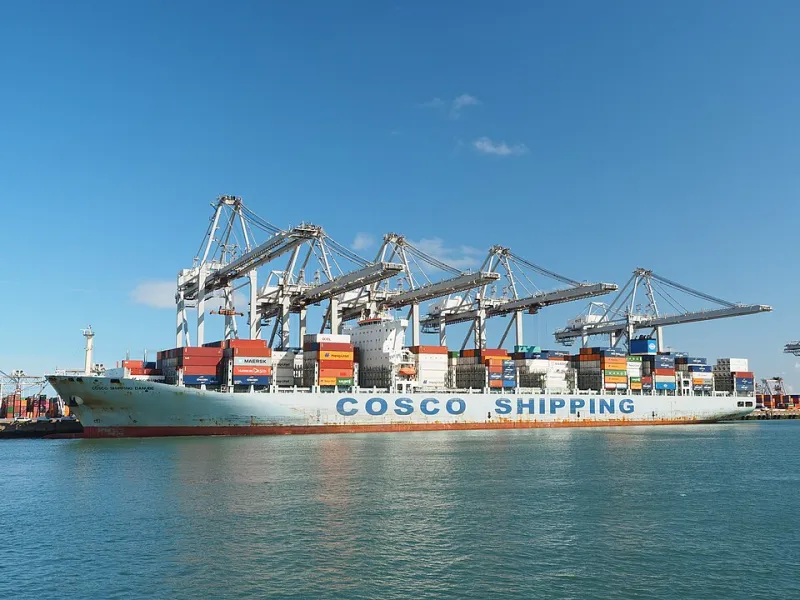
Photo: Stephanie Abdullah, Public domain, via Wikimedia Commons
There is a particular kind of confidence that comes from operating a well-oiled supply chain. American companies that have spent years optimizing freight lanes, consolidating distribution centers, and squeezing efficiency out of just-in-time inventory models tend to carry that confidence into new markets. In the Gulf, that confidence can be expensive.
The Middle East does not simply add complexity to a supply chain. It exposes the assumptions baked into it.
The Illusion of Familiarity
On paper, the UAE looks like an ideal logistics gateway. Jebel Ali is the largest port in the Middle East and among the ten busiest in the world. Dubai International Airport moves more international cargo than almost any facility on earth. Free zones offer streamlined customs procedures and tax incentives that seem almost too good to be true.
The problem is not infrastructure. The problem is that Western supply chain models are designed for stable regulatory environments, predictable transit corridors, and customer bases that tolerate modest lead times. The Gulf offers none of those things consistently.
Geopolitical volatility in the broader region can shut down shipping lanes with little warning. Regulatory frameworks in individual Gulf Cooperation Council (GCC) states—Saudi Arabia, Kuwait, Qatar, Bahrain, Oman, and the UAE—diverge significantly despite surface-level economic integration. A shipment cleared through Dubai may face an entirely different compliance process upon reaching Riyadh. And port congestion at Jebel Ali, while not chronic, spikes unpredictably during peak trade seasons and regional disruptions, creating delays that cascade through downstream fulfillment.
For a US exporter running a centralized hub model—consolidating inventory in a single regional warehouse and distributing outward—these variables are not inconveniences. They are structural threats.
Case Study: A Midwest Industrial Supplier Rethinks Everything
Consider the experience of a mid-sized Ohio-based manufacturer of industrial fasteners and hardware components that entered the UAE market in 2019. The company established a single bonded warehouse in a Dubai free zone, expecting to serve the entire GCC from that location. Within eighteen months, the model was straining.
Saudi customers—who represented the company's largest regional revenue opportunity—were experiencing average lead times of twelve to seventeen days due to cross-border documentation requirements and customs inspection queues at the Saudi-UAE border. Qatari distributors, dealing with the residual effects of the 2017–2021 Gulf diplomatic crisis, had developed a preference for suppliers with in-country inventory buffers. Bahraini buyers were simply choosing regional competitors who could deliver faster.
The company's response was instructive. Rather than doubling down on the Dubai hub, it partnered with a Riyadh-based third-party logistics provider (3PL) to establish a forward stocking location in Saudi Arabia's industrial corridor. It negotiated a revenue-sharing arrangement with a Qatari distributor that included dedicated shelf space in a Doha warehouse. Lead times dropped to three to five days for its two largest markets. Customer retention improved measurably within two quarters.
Why Distributed Inventory Works in the Gulf
The logic of distributed inventory in the Middle East is not complicated, but it requires a willingness to accept higher carrying costs in exchange for resilience and speed.
Each GCC country maintains its own import documentation requirements, product certification standards, and customs inspection protocols. Saudi Arabia's SABER product conformity platform, for instance, requires product registration and shipment certification that adds time and administrative burden to every cross-border transaction. Holding pre-cleared inventory inside the Kingdom eliminates that friction for repeat orders.
Beyond compliance, there is the matter of customer expectation. Gulf B2B buyers—particularly in construction, energy, and healthcare sectors—have grown accustomed to rapid fulfillment from regional suppliers. A US exporter competing on price alone will lose to a regional competitor offering faster delivery. Competing on both price and speed requires proximity to the customer, which means inventory placement, not just logistics optimization.
Regional 3PLs play a critical role in making this model economically viable. Unlike asset-heavy logistics operators, established Gulf 3PLs offer flexible warehousing arrangements, local customs expertise, and last-mile delivery networks that would take years and significant capital for a US company to replicate independently. Several US exporters interviewed for this piece cited their 3PL partnerships as the single most consequential operational decision they made in the region.
Nearshoring to the Neighborhood
A growing number of US companies are taking distributed inventory a step further by establishing regional assembly or light manufacturing operations in UAE free zones. The Khalifa Industrial Zone Abu Dhabi (KIZAD) and Jebel Ali Free Zone (JAFZA) both offer infrastructure and regulatory frameworks designed to support value-added manufacturing activities.
This approach—sometimes described as nearshoring to the neighborhood—allows companies to ship components or semi-finished goods from the United States in bulk, reducing per-unit freight costs, and complete final assembly or packaging regionally. The result is a supply chain that is simultaneously more cost-efficient and more responsive to local demand fluctuations.
For US exporters in sectors such as medical devices, electronics, and consumer goods, this model also addresses product localization requirements. Gulf markets increasingly expect Arabic-language labeling, region-specific certifications, and in some cases product modifications to meet local standards. Performing these steps regionally, rather than in US facilities, reduces the cost and complexity of maintaining multiple SKU variants.
Building for Disruption, Not Against It
Perhaps the most important mindset shift for US companies operating in the Gulf is moving from disruption avoidance to disruption absorption. The region's geopolitical environment—while not uniformly unstable—carries a baseline level of unpredictability that no logistics optimization can fully eliminate.
Companies that build supply chains designed to absorb shocks rather than prevent them tend to outperform those focused purely on efficiency. That means maintaining safety stock at distributed locations rather than running lean inventory across a single hub. It means qualifying multiple freight carriers and customs brokers rather than relying on a single preferred vendor. And it means building contractual flexibility into 3PL agreements so that warehousing footprints can expand or contract as market conditions shift.
The Gulf is not a market that rewards the supply chain playbook refined in Cincinnati or Dallas. It rewards the companies willing to build something new—something designed specifically for the terrain.
For US exporters serious about long-term commercial success in the Middle East, that reconstruction is not optional. It is the foundation on which everything else depends.